If you've spent any time on social media lately, you've probably seen classroom after classroom that looks absolutely perfect. Everything matches, every shelf is color coordinated, and every plastic bin has a cute label.
After teaching first grade for 35 years, I can tell you that's not what makes a successful classroom. A well-organized classroom isn't about making everything look Pinterest perfect. It's about creating systems that help your students become independent and make your school day run more smoothly.
In this post, I'm sharing some simple classroom organization ideas that will help you know exactly where to start. Instead of trying to organize every drawer, every shelf, and every one of your classroom materials, you should focus on four important areas first.
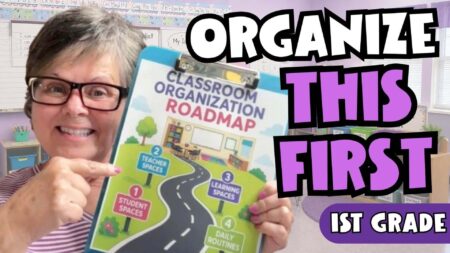
Don't Try To Organize Everything At Once
Before we start, have you ever started cleaning out a closet thinking it would take about an hour? Then, five hours later you're sitting in the middle of a giant mess wondering why you ever started. I don't want that to happen in your classroom.
One of my favorite practical tips is to choose just one area to organize before moving on to the next. It's a great way to avoid feeling overwhelmed, especially if you're in your first year of teaching or getting ready for a new school year. Instead of trying every classroom organization hack you see online, follow this simple roadmap.

1. Organize Your Student Spaces
Let’s begin with student spaces. These are the places that kids are going to be using and interacting with every day. And so the goal of organizing student spaces is to help kids be independent without constantly asking you where things go. Keep these 3 things in mind when organizing student spaces:
Give Everything A Home
Every item students use should have a permanent place. Math games belong in the math center.Art supplies belong in the art center. Phonics games belong in the word work center.
When students know exactly where things belong, they spend less time asking questions and more time learning. Labeling storage bins, tubs and basket will help kids keep things organized.
Keep Supplies Within Easy Reach
If interruptions are a problem in your classroom, keeping supplies within each reach for kids will help. Students should never have to interrupt you because they need another pencil.
Keep extra supplies like pencils, crayons, scissors, glue sticks, and paper where students can easily get to them. . Shelves should be the perfect size for young learners so they can grab what they need without help. This simple change is a game changer for classroom management because students become much more independent.
Let Students Put Things Away Independently
As you're organizing your classroom, keep in mind that dyou want students to be as independent as possible in your room. They should be able to clean up without asking you where everything goes.
This means that their cubbies should be labeled. Their student mailboxes should be easy to reach and labeled with their name or number. Turn-in baskets should be clearly marked.
The biggest rule is this: If students use it every day, make sure these items are clearly labeled so that kids can put it away by themselves. Organizing your classroom in a way that builds independence will save you a lot of time throughout the year.
2. Organize Your Teacher Space
The next area to organize is probably the place you spend the most time in…your own workspace. Whether you work from a teacher desk, a teacher table, or even a rolling cart, having a good classroom organization system will save you so much frustration. These are the classroom organization ideas to keep in mind in yorur teacher space:
Keep Daily Items Nearby
The things you use every day should always be within arm's reach.
Pens.
Scissors.
Paper clips.
Band-Aids.
Sticky notes.
Your planner.
If you find yourself getting up every few minutes to look for something, it's probably not stored in the best place. Keeping your most used supplies close by gives you extra time to spend with your students instead of searching through drawers.
Create A Paper Management System
Every teacher needs some type of paper organization system. You're going to have homework to grade, parent notes, office memos, student complete work and other important papers to keep track of. So having some kind o paper management system is very important.
Whether you prefer trays, file folders, or filing cabinets, choose something you'll actually use consistently. The goal isn't perfection. It's just to make it easier to keep track of all your paperwork, which will ultimately save you time in the long run.
Store Things Where You Use Them
As you're planning out your classroom organization ideas, think about the different items you reach for in each area of your classroom. Try to store supplies where you actually use them.
When you're planning out your small group table – what types o materials do you use there on a daily basis? Dry erase boards and markers? Magnetic letters? Word cards? Make sure you have enough of these items that you can store what you need in this area so that you don't have to constantly get up to fetch something from another place in the classroom.
Storing things that you use at the place where you use them, will ultimately save you time and make you much more efficient.

3. Organize Your Learning Spaces
This is where I see teachers make one of the biggest mistakes. Often teachers will organize for how the classroom looks instead of how students actually use the spaces in your classroom.
Your classroom spaces should always support learning. These are places like your classroom library, math and literacy centers, and computer station.
Organize For Student Independence
When you're organizing your student spaces, your ultimate goal should be student independence. Students should be able to walk into a center and know exactly what to do.
Materials should be labeled, directions should be clear and supplies should be within reach. Keep center materials stocked and nearby so students don't need to leave the area every time they run out of something.
Think About Traffic Flow
A well-organized classroom also makes it easy to move around. You'll especially want to avoid creating bottlenecks near the classroom door. Leave open pathways to the carpet, centers, and tables so it's easy to walk around the room without bumping into furniture. If you're planning out your learning centers, this free 28 page guide will walk you through everything you need to know to make center time your students’ favorite part of the day and stress-free for you! Grab this freebie here.

Create Purposeful Learning Areas
Every learning space in your room should have a purpose. or example, your classroom library is for reading. Your math center is for math manipulatives, games, and math books. . Your writing center is for writing.
When everything has a purpose, students stay focused and spend less time wandering around looking for materials.
4. Organize Your Daily Routines
The final area you want to remember when thinking about your classroom organization ideas are your daily routines. These are the things that you and your students do every single day. Think about things like:
Where do students sign in?
Where do they put their folders?
Where do they turn in papers?
Where do they keep snacks?
How do you take lunch count?
All of your daily routines need an organized location for both you and your students.

Organization Doesn't Have To Be Expensive
When you're planning out your classroom organization ideas remember that you don't have to buy every organizing product you see.
Yes, there are wonderful products like Iris Project Cases, shoe organizers, colorful storage bins, and rolling carts. Some of those tools really are helpful but they can be costly. Head to your local dollar stare and you an find lots of inexpensive options in fun colors that will look nice in your classroom.
As you're getting ready for the first day of school, don't worry about changing everything overnight. Pick one area and work on it to completion. Then move onto the next. You can start with a simple area like your teacher desk and then maybe tackle a larger area like your classroom library. The thing you want to avoid is trying to organize everything at once. That's a recipe or disaster.
Little by little, you'll build systems that last all year. You can continue improving your systems year after year as you discover what works best for your students.
Looking for more? Find out how to teach classroom routines and procedures that actually stick.


ABOUT THE AUTHOR
Hi, I'm Molly, the creative mind behind Firstieland. With over 35 years of experience in early childhood education, I'm your primary support for resources that will save you time and make learning feel like play. Learn more about my mission for Firstieland here.