Written by Molly Schwab, host of the Firstieland Podcast and YouTube channel
November 5, 2026
When you sit down for small group time, what are the rest of your students doing? Your classroom management strategies for small group instruction in first grade should include 4 basic areas: meet with teacher, centers, independent work and reading. Your classroom management strategy should teach kids where to go during each rotation and how to keep learning while you focus on student needs in small groups.
After three decades in the classroom, I learned how to keep my kids busy and learning with independent work, so that I could work with my small groups in peace. Let’s take a look at this simple classroom management plan that you can adapt for your own classroom too.

What’s The Rest Of The Class Doing?
Working with small groups of students is only one part of the equation during your guided reading time. You also need the rest of your class to know what they should be doing while you teach.
During our reading block, my students were in one of four places:
- Working with me.
- Doing independent work at their seats.
- Working at a classroom center.
- Reading from their book boxes.
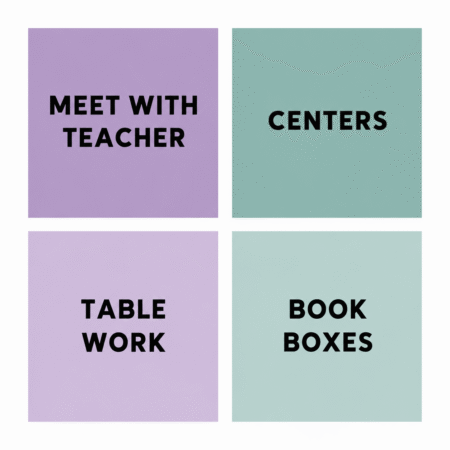
That was the basic system. Student engagement depended on having familiar activities they could manage at their skill level, rather than waiting for me to explain something new during every rotation.
Show Students Where To Start
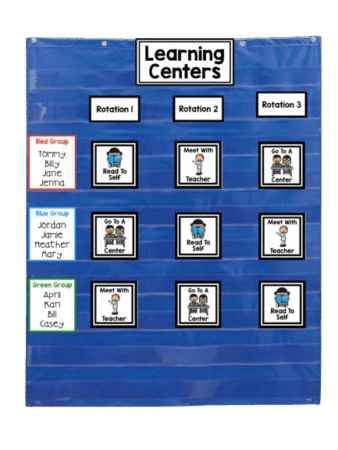
Before I could sit down for my small group sessions, everybody needed to know where to go and I used slides to help guide us during rotations. I had slides for Monday through Friday that showed the rotation schedule for the day and I would put that up on the board before we started. The kids could see where they were going during each rotation and it also helped me stay on track.
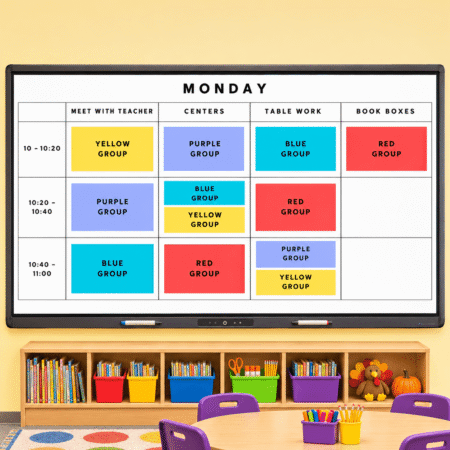
The slides and the daily routine really helped protect our instructional time because if you’re constantly answering, “Where do I go?” you’re losing minutes you could spend teaching.
Your rotation schedule could be a slide, a pocket chart, or an anchor chart. The important thing is that the whole class understands how to read it and remember to practice looking at the schedule and getting materials before expecting kids to do it independently.
Rotation #1 – Phonics Interactive Notebooks
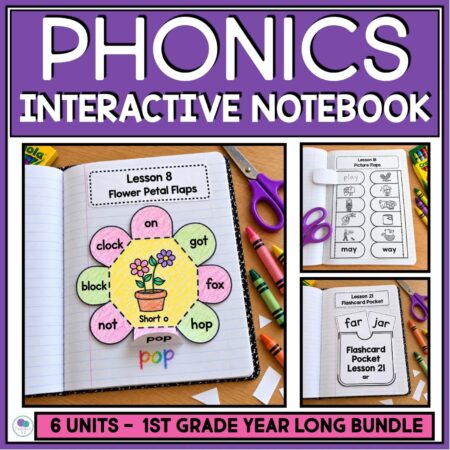
At the independent work rotation, the kids worked at their seats in their phonics interactive notebooks. They practiced whatever skill we were learning in whole-group instruction that week. For instance, if we were working on the vowel teams ai and ay, their notebook pages practiced that same skill. Our small group work usually took about 15 minutes per group, and that’s about how long it took for kids to complete their notebook. So, it fit into our reading block perfectly and great independent practice.
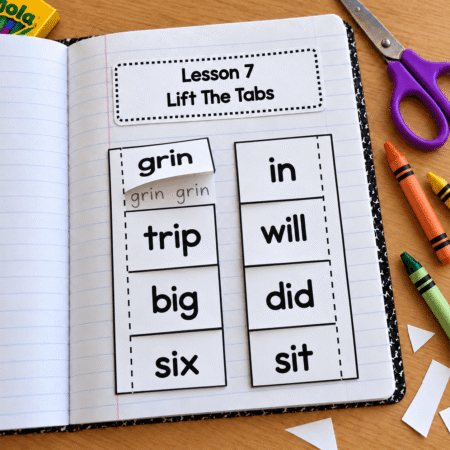
Every day they had a different activity in their phonics interactive notebook, but the page styles were familiar. On Mondays, they did Flashcard Pockets, where they cut out a little pocket and their new words, glued the pocket into their notebook, and used the cards to practice.Other days, they did lift-the-flap pages, spelling sentences, ABC order, or tracing and building words.
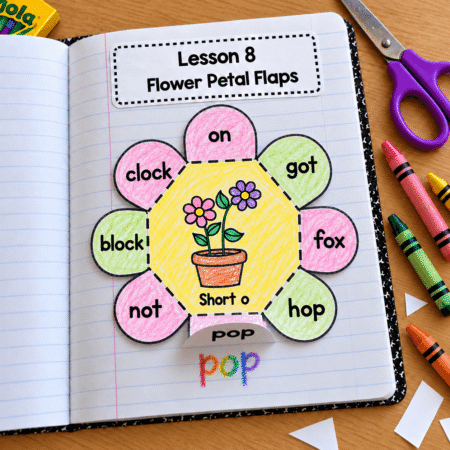
The pages stayed in their composition notebooks, so they had a little collection of skills they could practice all through the year. The interactive notebooks gave student learning a purpose beyond just doing a worksheet.
Rotation #2 – Classroom Centers
At the second rotation, kids would be at centers. I had ten centers, which might sound like a lot, but several of them needed very little upkeep and I only changed the materials once a month. My centers were:
- Writing
- Big Book and Retelling
- Library
- Listening
- Word Work
- Art
- Math
- Spelling
- Computers
- Tablets
I changed the materials for some of the centers monthly but the routines stayed the same. I always put games and activities that we had completed in whole or small group so the kids knew how to use the materials appropriately.
For elementary teachers, that can make planning feel much more manageable. You don’t need ten brand-new activities every week. You need activities your students understand, with different ways to practice familiar skills.
Classroom Center Management
There were 3 basic things that led to student success at our centers:
- Only one student at a time was allowed at a center.
- Kids had a simple log that they kept track of the centers they had visited.
- Center managers were assigned to each center
One Student At A Center
I chose to have one student at a time at a center because I found that with a bigger group size there was too much talking and social interaction and not enough working at the center. When I had 4 kids or even 2 kids at a center, they would talk and be noisy and I had to spend a lot of time telling them to get to work and quiet down. So, for me, I found that one kid at a time was the best way for my room.
Learning Center Log
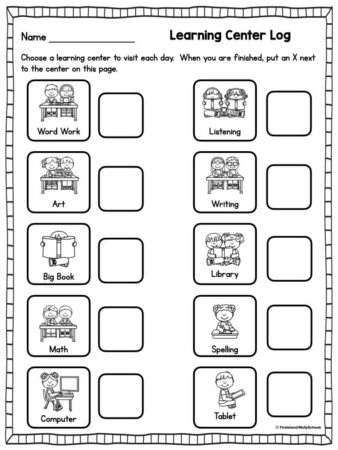
The students were in charge of tracking the centers they went to each day. As the classroom teacher, that eliminated a lot of work for me. The kids each had a station log with the name and picture of every center. When it was their turn for centers, they would get their log and choose a center they hadn’t visited yet.
At the end of center time, they checked off the center they visited on their log and the next day, they chose a different center. Since there were ten centers and the kids only went to one a day, it took about two weeks to visit everything. After they had been to every center, they got a new log and started over.
Center Managers
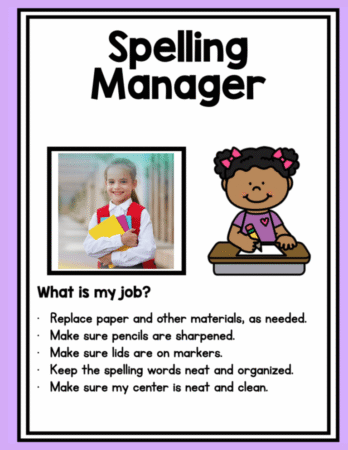
One of the best practices I implemented was assigned a manager to each center. It was their job to make sure the center had all the supplies and was neat and cleaned up after small group time. The center manager also answered any questions or students needs during small group time. It was a great way to eliminate a lot of interruptions to me during small-group time. Grab the complete center management system here.
What Were Students Doing At Centers?
During small group learning time, some students would be working independently at centers. Some of the centers included:
Writing And Spelling
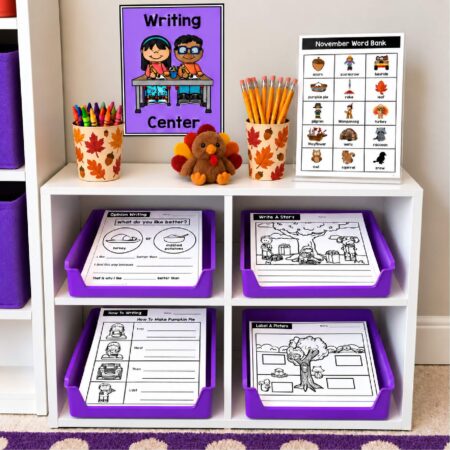
At the writing center, kids might be writing a story, making a list, labeling a picture, or creating a greeting card. I changed the writing templates once a month and added seasonal pencils and erasers to make it inviting. But the kinds of writing stayed familiar, so the kids knew what to do.
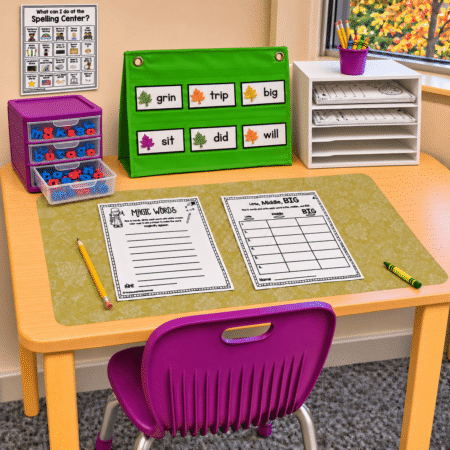
At the spelling center, I had our weekly words in a little tabletop pocket chart and four or five activity templates to choose from. They might do rainbow writing, put their words in ABC order, or build them with letter tiles.
Word Work, Library, And Technology
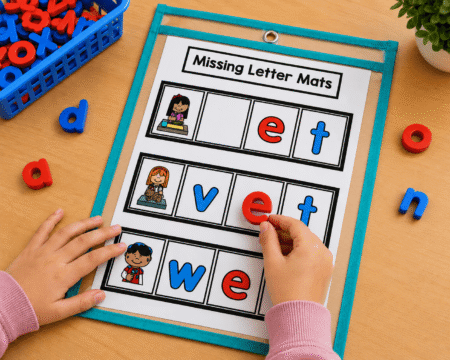
At word work, kids practiced building words in different ways, using magnetic letters, letter tiles, or even playdough.
At the library center, kids could look through our classroom books. To add variety, I added a basket of seasonal books each month, along with little pointers or reading glasses to make it fun.
Computers and tablets were another easy center to maintain. We used different learning apps, and I added new Boom Cards each month for different literacy and math skills. If you aren’t familiar with Boom Cards, they are like digital task cards.
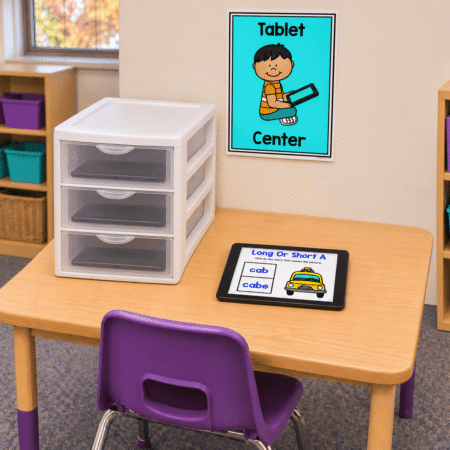
The thing that made our centers manageable was that I wasn’t starting over every month. The kids knew the routines, and I only changed the materials once a month
Rotation #3 – Book Boxes
The other independent rotation was book boxes. Every student had a box with about six to eight books they could read independently and they exchanged those books once a week, usually on Friday.
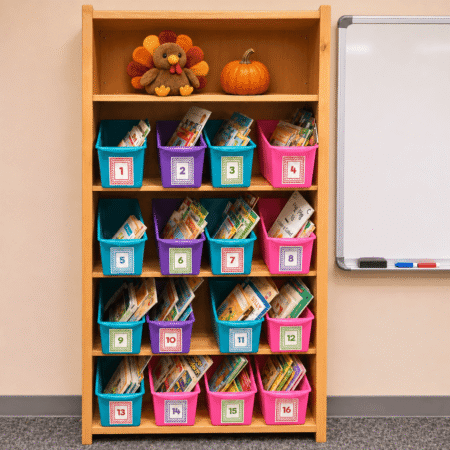
They chose books from our classroom library, which had labeled baskets of picture books, decodable books, and leveled books. I let them choose, but I also kept an eye on what they were picking because I wanted them to have books they could actually read.
During book box time, they could sit around the room in our bean bags and other comfy spots. There were basically only two rules: don’t sit next to somebody else, and no talking. They were supposed to be reading the whole time.
Transitions Between Rotations
At the end of each rotation, the kids who were working in small group with me put any work we did in their mailbox. The kids at centers put their work at their seats, along with their center logs and the kids with book boxes put them back on the shelf.
It probably took about three minutes between rotations. During that time, I quickly cleaned up from one group and got ready for the next one. Then I announced where the kids would go next, and we moved on.
Build those minutes into your plan. You need enough time for children to put materials away without rushing and leaving a mess for the next group of kids.
Small Group Instruction Time
As you get ready to implement these strategies into your reading block, check these five things:
- Students know how to clean up and move to the next rotation.
- Every student knows where to go and what to get.
- Independent activities practice skills I’ve already taught.
- Center materials are ready and familiar to my students.
- Students know how to get help without interrupting my group.
If you’d like to try using interactive notebooks as part of your rotations, you can check it out here. This year long bundle follows a typical first grade phonics scope and sequence, making word practice hands on and easy for kids to follow.
Save These Ideas For Later!
Take a minute to save these ideas to your favorite reading strategies Pinterest board so you can remember them later!

Hi, I’m Molly, the creative mind behind Firstieland. With over 35 years of experience in early childhood education, I’m your primary support for resources that will save you time and make learning feel like play. Learn more about my mission for Firstieland here.